
Friday Five
17/07/2026 - Paris Special. Or rather, The French Dispatch

Five for Friday
Every Friday I share five things that I’ve done or seen or thought about in the previous week.
I went to Paris for the first time in March 2014. I’d given up smoking in the January and I was very worried about the effect being in Paris would have on my resolve because I could see myself so clearly, sitting en terrasse, drinking a carafe of red wine and gesticulating wildly with a cigarette clamped between my index and middle fingers. But I’d had to give up you see, because I made a deal with the Universe that if it let me have a publishing deal then I’d quit smoking. And in the November of 2013 I got a publishing deal and it was going to be announced very soon—as it would turn out, while I was in Paris—and so when 2014 rolled around I kept up my end of the bargain (and obviously, looking at it now it was a double win for me—I got to give up this frankly disgusting habit and I’d also have one of my most secret dreams come true).
Before I got on the Eurostar the morning of the Paris trip I met my then-editor at St. Pancras and she gave me one of the proofs that were shortly going to be sent out BUT ALSO told me that the deal would be announced while I was in Paris—timed just before Bologna Book Fair for maximum hype!
Which was great but also a problem because at the time I didn’t have a phone that did anything other than take calls and let me send messages. It couldn’t take photos or connect to WiFi—I could tweet and update Facebook via text message, but that was it—to use the internet while I was away I was using a Kindle Fire tablet. So the deal was going to be announced and I couldn’t share it or respond to it unless I chained myself to the hostel and used my Kindle to watch what was happening. But I was in Paris! My first time! Paris is the centre of art and culture and literature and food and all good things! I couldn’t stay in the hostel for a moment longer than necessary!
Luckily, I was with a friend who was already comfortably living in the 21st century and she very generously allowed me to log into my social media to spread the news and soak up the applause.
The first time I was in Paris I saw the Moulin Rouge and the Sacre Coeur and the Amelie Café (Café des Doux Moulins) and up the Eiffel Tower (with the proof! I took photos of my book (on a camera!!!) at the top of the Eiffel Tower.). And I went to Shakespeare and Co and Versailles and Pere Lachaise and the Catacombs and a weird vampire museum that in another universe resulted in my sacrificial murder. And I had my book and my life was about to begin and so I have always, always loved Paris because it’s so linked with feeling like everything was about to get good. It was a beginning…
Going back at the beginning of this week only reaffirmed my love for Paris and this week’s Friday Five is therefore a Paris Special.
Opera: La Traviata
My nan loved opera. She liked classical music but she loved opera and I can still hear her singing along with Pavarotti in my head, the tremulous warble of an old woman. She liked Madame Butterfly and La Boheme especially, neither of which I’ve seen. In fact the only opera I’d seen before La Traviata was Rusalka a couple of years ago during the Local Gods Dark Times, because it was something I’d never experienced and I was in that zone of trying to cram as much novelty into my head to see if it would shake the story loose. I don’t know if it did, but I did like it and so when I was planning my brief Paris trip I decided to see if anything was on at the Paris Opera and lo and behold, Monday night was the last night of La Traviata (it is killing me not to call it La Trav) and I wanted a ticket.
But I couldn’t afford it and so—as with my publishing deal—I had a chat with the Universe and said, “Listen, I really want to do this but it’s too spenny so can you sort me out a cheaper seat?” and the Universe obliged. For fifty euro I got a row 29 stalls seat and that would have been great, BUT THEN the staff asked for volunteers to fill the more expensive seats that hadn’t sold, so I ended up much closer to the stage, dead centre, for the whole performance. Lucky, lucky, lucky.
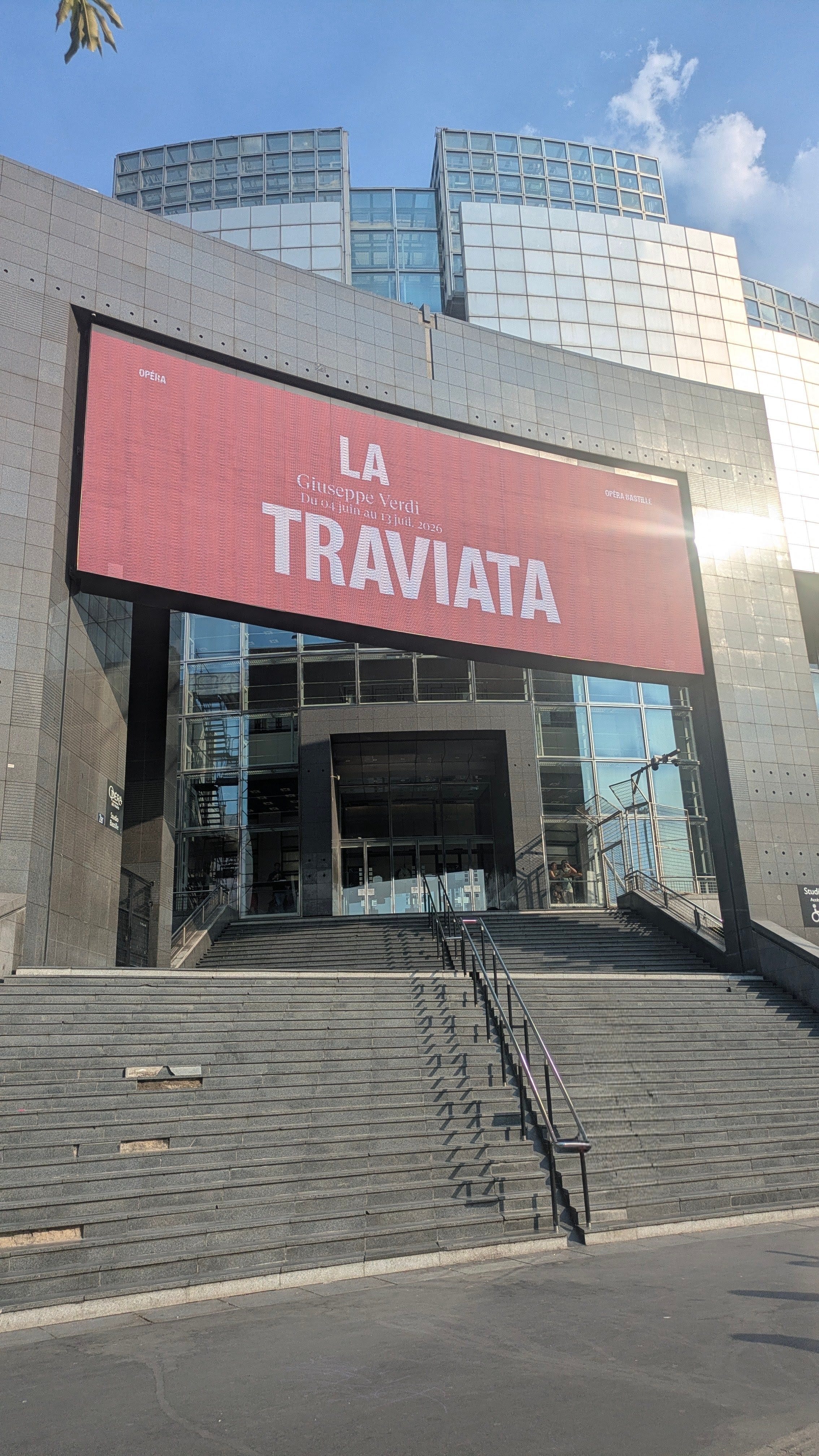
La Trav (fuck it, I’m doing it), is about the beautiful, glamourous Violetta, a courtesan who falls in love with Alfredo, a gentleman’s son. Violetta leaves behind her somewhat debauched life to live with Alfredo in the countryside, only to be visited by his father, Giorgio, who demands she leaves his son as their relationship is jeopardizing Alfredo’s sister’s marriage—her fiancé doesn’t want to be associated with a woman like Violetta. Violetta protests, then reveals she is dying but Giorgio won’t be placated and so Violetta, to save her lover’s sister’s reputation, leaves him and goes back to her old life, letting Alfredo believe she missed the excitement and glamour. When the two meet again at a ball, Alfredo throws the money he’s won gambling at Violetta’s feet, telling her it’s payment for her services for all those months she lived with him. Violetta is broken, and Giorgio is disgusted by his son’s behaviour and beginning to be revulsed by his own attitude too. But Violetta’s death approaches and she and Alfredo—and Giorgio!—are barely reconciled before she dies.
The Paris Opera version relocates the story to Paris and brought it bang up to date—Violetta is an influencer and brand ambassador, selling her image and self for fame and wealth. My favourite thing about the production was the set—two giant and rotating screens, set at a V, across which text messages and social media posts and website handlines were displayed, and in the second act the screens showed neon outlines of people engaging in graphic sex acts, to depict Violetta’s return to debauchery and scandal. Inside the V, the set was alternately a champagne reception, the back of a venue, complete with bins, a kebab shop called Paristanbul (I actually saw a real version of this near Gare de l’Est!), a country house, a hospital room and finally the gateway to the afterlife. It was minimal in concept but maximal in execution and it was genuinely delightful to and incredibly effective.
La Trav (fuck off) was sharp and funny and clever and beautiful and the singers were all incredible and the standing ovation at the end went on for so long my hands still hurt the next morning. And I think now I’m into opera?
Book: Down Below
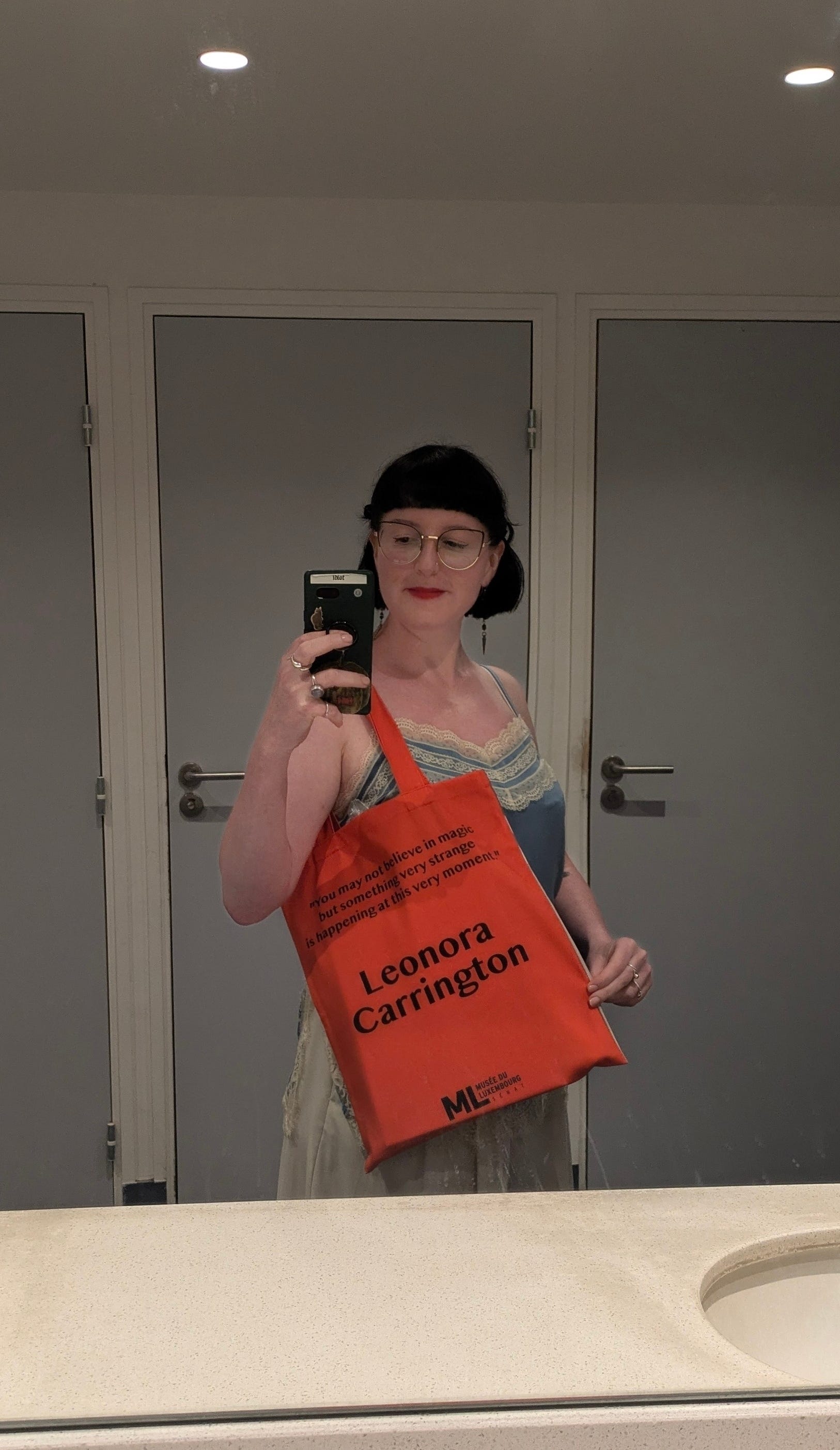
The main purpose of the trip was to see the Leonora Carrington exhibition at Musee de Luxembourg before it closes on Sunday. And so all the books I took to Paris with me were by or about Leonora Carrington.
Down Below, or En Bas in French—the language it was first written in—is around 100 pages long, detailing what happened before and during Leonora’s being committed to a sanitorium in Santander after she had a breakdown following the incarceration of her then-partner, Max Ernst, and her flight to Madrid to escape the march of World War II. In it she talks lucidly and candidly about believing she had a particular insight into the war and that she alone knew how to stop it. She talks about the car she and friend travelled to Spain in being ‘blocked’ and that she was also blocked and so was Europe and if she could just get someone to listen to her, everything could be unblocked and solved.
It’s clear to an outsider she’s in the grip of some pretty extreme delusions, her mind and body ravaged by the events in Saint-Martin-d’Ardeche, where she was living happily with Max before his arrest for being German. Isolated and persecuted and desperately afraid for herself and Max, she simply loses her mind, seeing villains and spies everywhere. Word gets back to her father who has long disapproved of her life and he uses his powers to have her committed to a sanitorium in Spain, where she undergoes diabolical treatments… And when she’s finally released, it’s only to be sent to another sanitorium in South Africa, where she knows she’ll never escape from.
It’s a hard read because she is twenty-four and estranged from her family and living in France with a married man so much older than her. And then she loses him and can’t go home, so where does she go? She goes, I think, inside herself, and it takes a while for her to come back out. But when she does, she is her whole self – her dependence on Max is gone and she can see now this relationship, while utterly cherished, would have subsumed her eventually and now she knows she must live on her own terms and not rely on being saved. She saves herself, in the end, and that’s powerful.
Exhibition: Leonora Carrington
I have a mildly embarrassing story about this which I’m going to share with you. I heard about the exhibition earlier in the year and misunderstood the venue, believing Musee du Luxembourg meant ‘Museum of Luxembourg’, which made sense in my head because Luxembourg is a small country and why wouldn’t they call their museum the Museum of Luxembourg? I looked up flights and accommodation but it was too expensive and a little unwieldy to get there for what I thought would essentially be one night. And I was heading to Germany to see friends in April and I thought “Hey, I bet I could get a train to Luxembourg from there!” and I was right, I could, kind of, but it was also expensive and complicated and it felt a bit impossible too. So I was resigned to not going to this exhibition, but I told myself I did see Rebel Visionary at Newlands House Gallery two years ago and I knew there was The Symptomatic Surreal at the Freud Museum, so I didn’t feel too hard done by.
AND THEN! I was on Instagram, scrolling through Chloe Coles’ birthday carousel and I noticed some Carringtons in her photos BUT SHE WAS IN PARIS. And I messaged her and she was like, ‘Yeah, the exhibition is amazing!’. Then I remembered the Jardin du Luxembourg—famously also in Paris… The exhibition was never in Luxembourg, the country, at all! It was right there, a convenient Eurostar away! But it was still a little expensive to go to Paris for an exhibition and I’d already done the go-to-Switzerland-for-Cezanne thing, so I self-vetoed it again (I need to stop limiting myself, especially when I can rely on others to do it for me).
AND THEN. I went to the Symptomatic Surreal Symposium in London, which was two days of Carrington scholars talking about Carrington and of course they’d all been to Paris and my envy grew and grew. And so I had a chat with my excellent friend, the Universe, and made it clear I wanted to go and I’d love a little cash bonus to facilitate that.
Two hours later I got an email from my agency saying a group of schools wanted to license one of my books and the amount they were offering was exactly what it would cost to get the Eurostar to Paris and stay in a hotel for three nights (I am too old for hostels now, I scare the young people with my crone aura, a harbinger of doom to come) and the price of the exhibition ticket.
So I went.


And I don’t know what to say except I was in there for over three hours and I took copious amounts of photos and made notes and when I came out I spent a lot of money on books and postcards and a poster and a magnet and a small moon that says ‘Chance’ on it (luck) (please buy my books, I am poor again) and then I ate a fancy patisserie with a Carrington-esque chocolate mask on it and then I floated back to the 10th Arr, where I was staying and had dinner and made more notes, none of which I want to share yet and that’s why you got the embarrassing story instead. I love her. I think she’s brilliant. It would have been worth going to actual Luxembourg for.
Exhibition: Hilma af Klint
I also saw the Hilma af Klint exhibition at the Grand Palais on my last morning in Paris. Like Carrington, af Klint was also deeply influenced by the occult and she actively used it in her art and she also had particular associations with colour and its meaning, so it was fascinating to me to see how such similarities manifested so differently in their practice.
It turns out that af Klint was one of the first Abstract artists, her work predating the more famous Mondrian and Kandinsky, though this was only discovered after her death because she demanded her work be neither shown nor sold until twenty years after she’d died.
af Klint belonged to a group called The Five, a circle of women including Sigrid Hedman, Anna Kassel, Cornelia Lederberg and Mathilda Nielsson, who banded together from 1896 to 1910 and shared a belief in the importance of trying to contact the High Masters – enlightened spiritual beings—to help deliver their messages through art. Members of the group used psychography, or automatism, to do so, making a stylus out of a flat piece of wood on wheels with an opening for a pencil. They’d then open themselves up to influence of the High Masters, who’d communicate through the artists to create drawings.
As a result, af Klint’s early works bear a pretty strong resemblance to the kinds of drawings I did as a kid with my Spirograph. I mean this as a compliment and now I’m wondering if I could have been channeling some kind of otherworldly influence when I was using my Spirograph and if I should get on Ebay and try to find one because I don’t think I have the skills to make a psychograph.
The Surrealists would also use a kind of automatism a decade later, hoping to override their consciousness to see what they produced without its influence. Possibly they knew about The Five and borrowed their techniques, adapting them to suit their needs.
What was most interesting to me in seeing af Klint the day after Carrington was how, despite their fascination with the occult and arcane, they had such different views of the roots of essential humanity. Carrington was super convinced of our connection to animals and the blurred lines between us and them—human/animal chimeras as a theme and the repeated use of animals are present in everything she creates. But af Klint was a proponent of the spiritual as the root of human essence and she believed in the circulation of the human soul, damaged by the fall to the earthly realm, her work about the struggle of spirit and matter to the end of spiritual emancipation.
af Klint’s work is deeply concerned with the span of human life and her works repeatedly show this, especially the sixteen paintings in the Evolution series, and Ten Largest charting the journey from babyhood to old age. These sequences are part of the collection of 196 paintings that af Klint believed she painted under the direct influence of the High Masters, for The Temple—though af Klint didn’t know what exactly The Temple was. She also felt that after completing the these paintings the spiritual guidance of the Old Masters finally ended, though she continued to paint abstract act.


Her work is beautiful and colourful and bold and unapologetically queer – she paints gender fluidity and celebrates a third gender as the pinnacle of spiritual development – I feel very lucky to have seen two huge exhibitions celebrating these fearless women painters exploring the sublime.
af Klint left all her abstract paintings to her nephew and specified that her work should be kept secret for at least twenty years after her death in 1944. When the boxes were finally opened at the end of the 1960s, the revelations that followed would change how Abstractism was understood.
Place: Point Zero
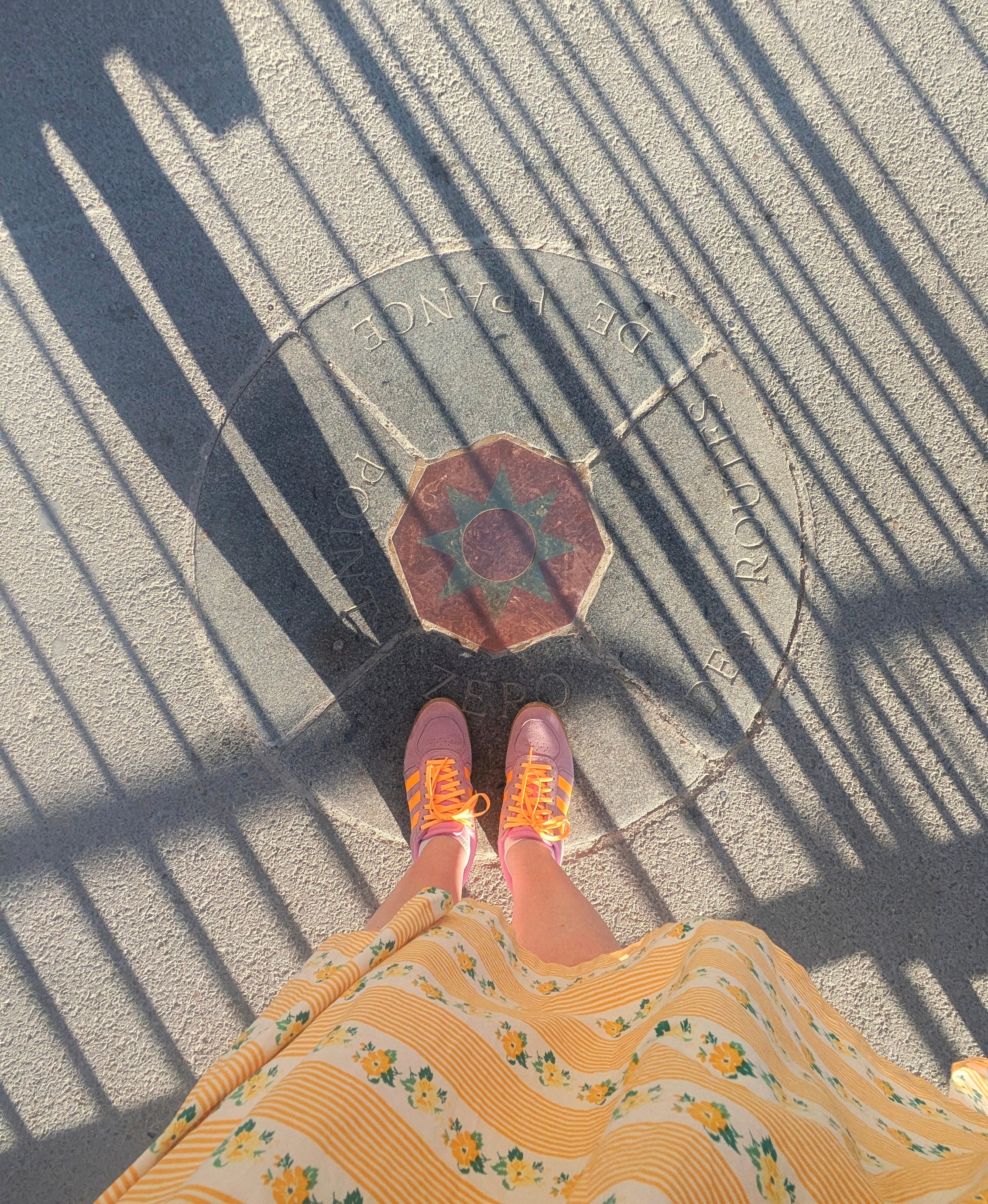
The first time I came to Paris I went to stand on Point Zero outside Notre Dame because I’d read about it in a YA book called Anna and the French Kiss, which is to my mind the most romantic book of all time*. In AatFK, the titular character Anna learns about Point Zero when a handsome boy called Etienne St. Clair takes her there and tells her that POINT ZERO DES ROUTES DE FRANCE means ‘point zero of all the roads of France and so it’s the point from which all other distances in France are measured.
“It’s the beginning of everything,” he says.
Then he tells her to stand on the star in the centre and make a wish. And that anyone who stands on Point Zero is destined to return to Paris some day.
Back in 2014 (four years after AatFK was published and the year Isla and the Happily Ever After, also set in Paris, was being published) Point Zero was HOPPING. You literally had to queue to stand on it and make a wish and everyone was taking photos of their feet on it too, to prove to the Powers they’d been there and made their wish, I guess? After you’d done Point Zero you went over to Shakespeare and Co to buy a book, and so I did that. I bought a book of Neruda poetry because in AatFK St. Clair buys Anna a book of Neruda poetry and I got it stamped.
Also back then you didn’t need to queue to go inside, you could just go right in and look at books and sit down and read or have a little nap in a nook.
It was a whole thing.
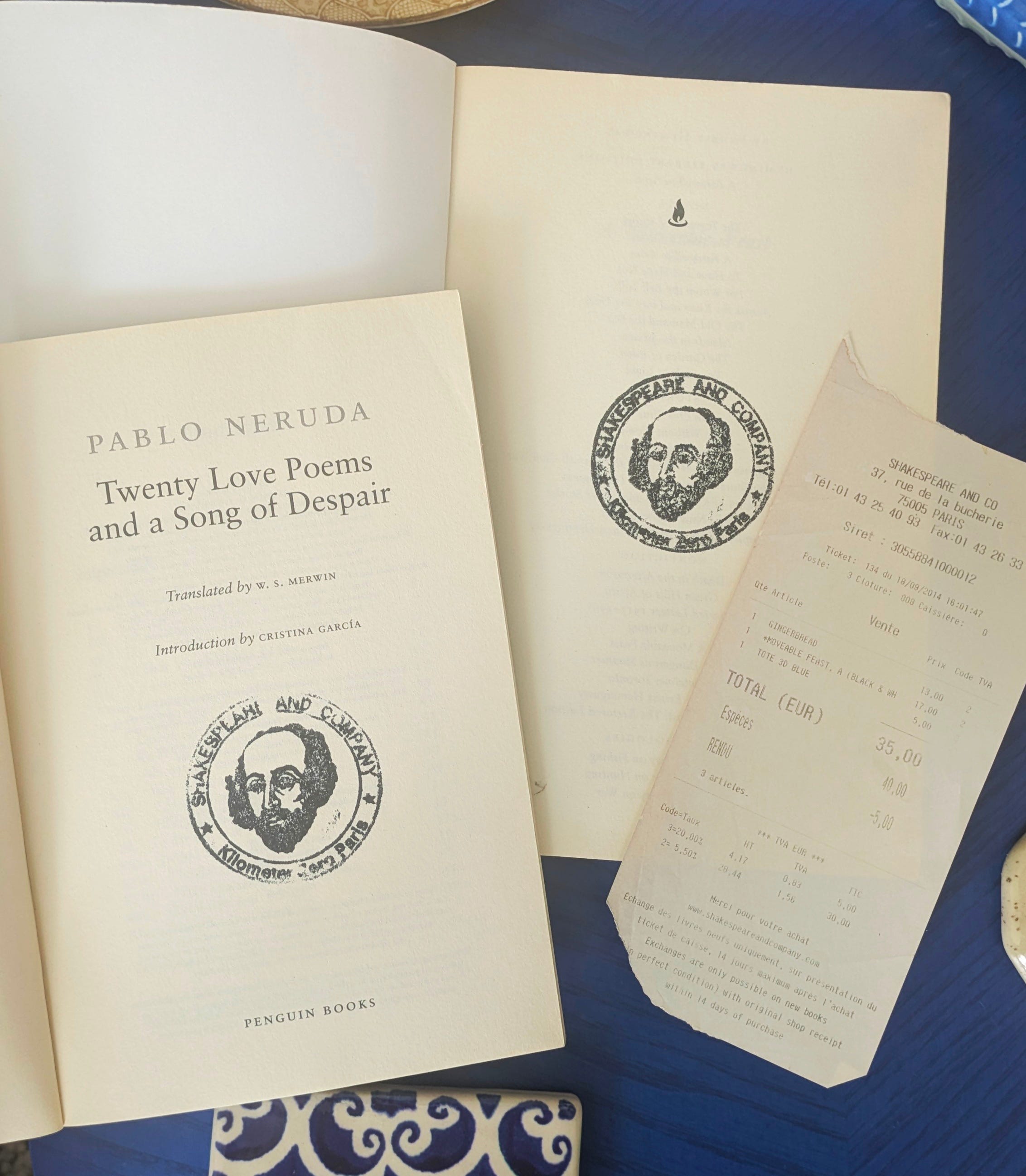
The second time I went to Paris (actually September 2014) I did it again: Point Zero then Shakespeare and Co, and this time I bought Hemingway’s A Moveable Feast and had that stamped. On this second trip I was actually doing something called The HemingWay, which was a jury-rigged attempt to see and experience Paris as Hemingway had – it mostly involved going to Les Deux Magots and Café de Flore and drinking wine, and eating steak frites at Polidor and using the Turkish toilet and thinking about how much easier it would have been to use it as Hemingway, a man, and just point and shoot.
But this time when I went to Point Zero no one was waiting to stand on it. No one was anywhere near it. So I stood on it and made my wish and did a spin for extra luck and took a photo of my feet. And this time I didn’t cross the river to Shakespeare and Co because I think it would have broken my heart to see people queuing to go inside because they saw it on TikTok and not because they’re weird little literature freaks and hoped to inhale the dead skin dust of Burroughs and Nin and Ginsberg and Joyce and Hemingway and Stein and Fitzgerald and Pound and countless other writers who’d been there.
The kids need to get off TikTok and start reading more Stephanie Perkins is the takeaway from this. But I went to Point Zero. And I wished. And now my return to Paris is assured.
“It’s the beginning of everything.”
Adieu, adieu.
*I read it on the train to Wales and I missed my stop because I was so into it. My stomach kept flopping around like a fish out of water. There’s not even any spice, as the TikTok kids say. It’s the yearning. Sweet Jesus, do these people yearn.