
Friday Five
26/06/2026 (pleasing!)

Five for Friday
Every Friday I share five things that I’ve done or seen or thought about in the previous week.
Play: Arcadia by Tom Stoppard
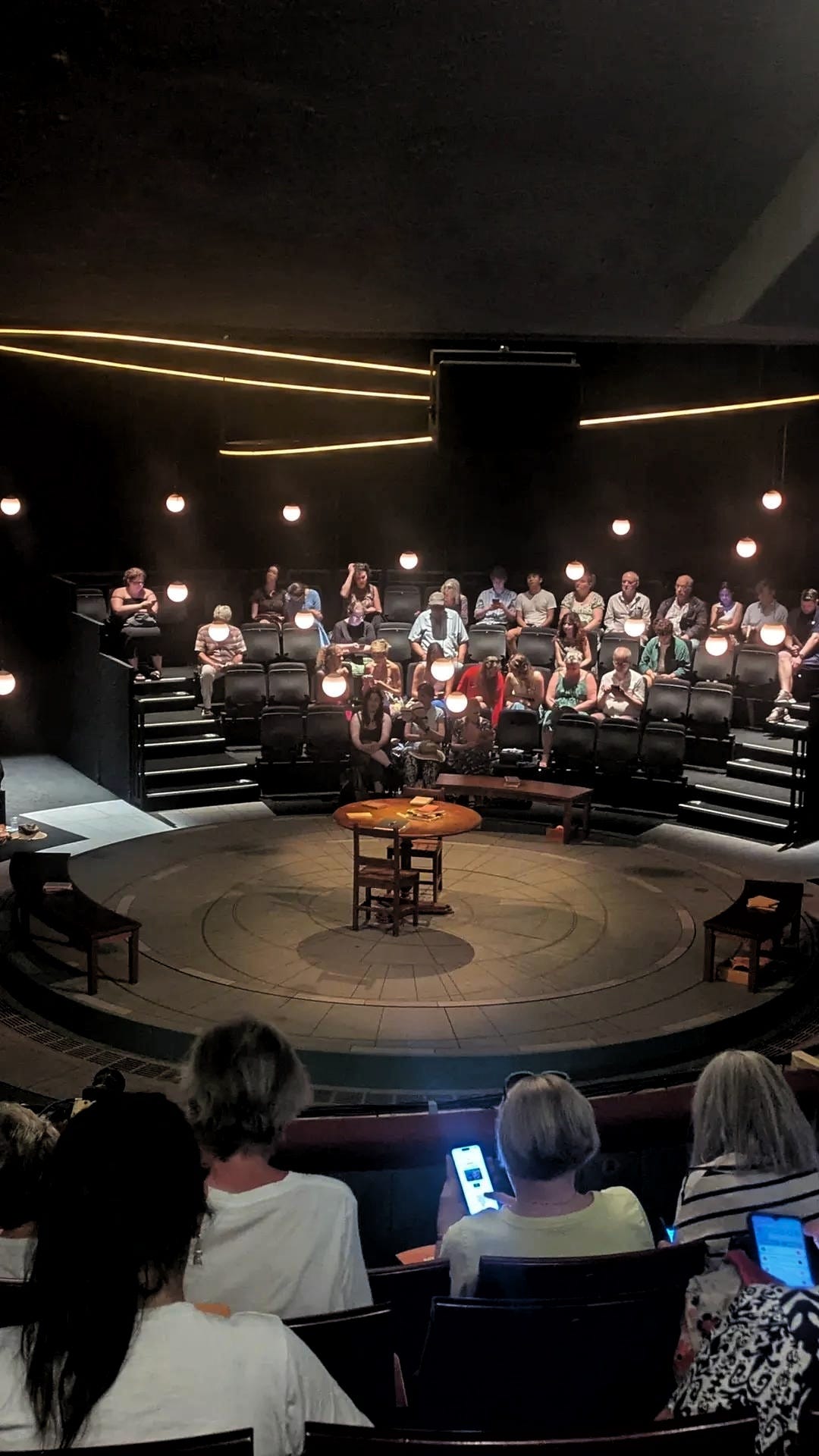
I was so, so happy to see Arcadia again! I watched it at the Old Vic earlier this year and THE SECOND I learned it was getting a West End transfer for a limited run I knew I’d go again.
Arcadia is set across two timelines. In the past, the brilliant Thomasina Coverly is being educated by her tutor, Septimus Hodge, a friend of Lord Byron, at Thomasina’s home, Sidley Park. In the present, academics Hannah and Bernard are both at Sidley Park researching their own interests – Hannah wants to solve the mystery of the hermit of Sidley Park, while Bernard believes he’s uncovered something previously unknown about Lord Byron. As the present unveils the past and what was lost is rediscovered, so the past—through Thomasina’s preemptive discoveries—reveals a future that was unimaginable to those living at the time.
The play is often called Stoppard’s best and it’s definitely my favourite of his. Arcadia deals in huge ideas about Chaos Theory, entropy, and using algebra to map everything, determinism. But despite that—and despite me being useless at maths and physics—it’s the most engaging and invigorating play I’ve seen in ages. It thrives in its contradictions: chaos versus order, past versus present, facts versus feelings, Classicism versus Romanticism. But ultimately, it all exists all at once. Now and then and yesterday.
And it’s so funny too! It’s so fast and witty and clever! It made me feel clever for being able to keep up with the humour, even if the science escaped me.
The only thing I ever want from any art I engage with is to feel like it’s opened a door in my head to a room I didn’t know was there before, and Arcadia does exactly that. It’s on at the Duke of York’s Theatre in London until September 12th and I’m going to go at least one more time. AT LEAST.
Book:
After reading HEART THE LOVER by Lily King, I reserved WRITERS AND LOVERS, which HEART THE LOVER is a somewhat sequel to (that is a spoiler).
While HEART THE LOVER focused on Casey’s relationships when she was at college and the lifelong fallout of the love triangle she found herself in, WRITERS AND LOVERS introduces us to how she met her husband and how they came together.
Aspiring novelist Casey, a former child golf prodigy-turned-waitress, is feeling a little adrift, watching her friends give up their dreams of writing one by one. She’s still trying to finish her novel but her progress has been thwarted by the sudden death of her mother, leaving her grieving and gently worried about the future. At a launch party for local author Oscar Colton, she meets Silas and is instantly attracted to him. But he ghosts her after one date, claiming he has to leave town. And in the meantime Casey meets Oscar properly and Oscar, who hasn’t dated since his wife died, leaving him parenting their two sons alone, decides Casey is worth breaking his dating fast for. When Silas returns, eager to pick up where he believes he and Casey left off, Casey finds herself in something of another love triangle. But she’s also finally finished writing her first novel and suddenly her life is starting to take real shape…
There’s a proper sense of life beginning in the book, which is refreshing given Casey is thirty-one and has already watched many of her peers settle into “grown up life”. The writing is beautiful; direct and punchy but beautifully wrought at the same time, each sentence feeling precision crafted. It takes the tropes of the starving artist condemning themselves to a piecemeal life to achieve their dream and spins it into something deeper and more hard won and, like Arcadia, it works best when it plays up to the contradictions and frictions of life and forces them to rub up against each other. Casey is a witty, sympathetic main character and Lily King is very good at inviting readers into her mind. A lovely book to read during a heatwave and really satisfying to read after HEART THE LOVER and getting to see how it ended for Casey.
Hobby: Ink and pens
I don’t know if it’s another kind of protest against the horrific and insidious creep of digitised life but in the past year I’ve got really into writing with fountain pens and using inks. It started in Germany, as most of the loveliest parts of my life do, watching my friend Katja sit and refill her pens. She has a vast collection of pens and inks and mine is small by comparison, but it’s early days. I’ll catch up.
Cleaning the nib and watching the ink swirling in the water (and now I’m thinking about Arcadia again and Thomasina saying you can’t unswirl jam in rice pudding by moving the spoon backwards – that once it’s mixed, it’s forever mixed). Choosing the ink you want to work with this time. Filling the converter cartridge carefully and fitting it in the pen. Moving the pen across paper to make the ink flow and use up the last of the old ink that didn’t swirl away. The moment the new ink overwhelms the old and becomes dominant (but for a couple of strokes they were in harmony!). I liked how meditative it seemed and I liked all the colours and I liked the way the ink looked on the page and I decided I wanted that too.
So I stole some pens from Katja to get me started and then I bought some of my own and I bought inks too. Pots of red ink that smell of roses, violet ink scented with violets, blue ink perfumed with lavender. Grey ink that looks like quicksilver on the page, a yellow-green ink with gold sparkles in it.
All the pens and inks have a different jobs—the lavender is for notes and reminders, the red in my diary, the violet in my journal. The gold is for my Commonplace book and the grey is for handwriting out scenes from my next book in the notepad dedicated to it.
I like how deliberate it is, to use a pen and ink. I like how it makes me feel. Along with my MP3 player and my DVDs I feel like I’m actively making better choices about what I do and consume and how I do things. In an age where so much is thoughtless by design (I think we’re supposed to call it convenience), writing by hand feels like a thoughtful act and while I know I’m very far from the first person to think this, I am glad I’ve caught up. INK FOREVER.
Film: Threads
Jesus FUCKING Christ, this was a grim, grim watch.
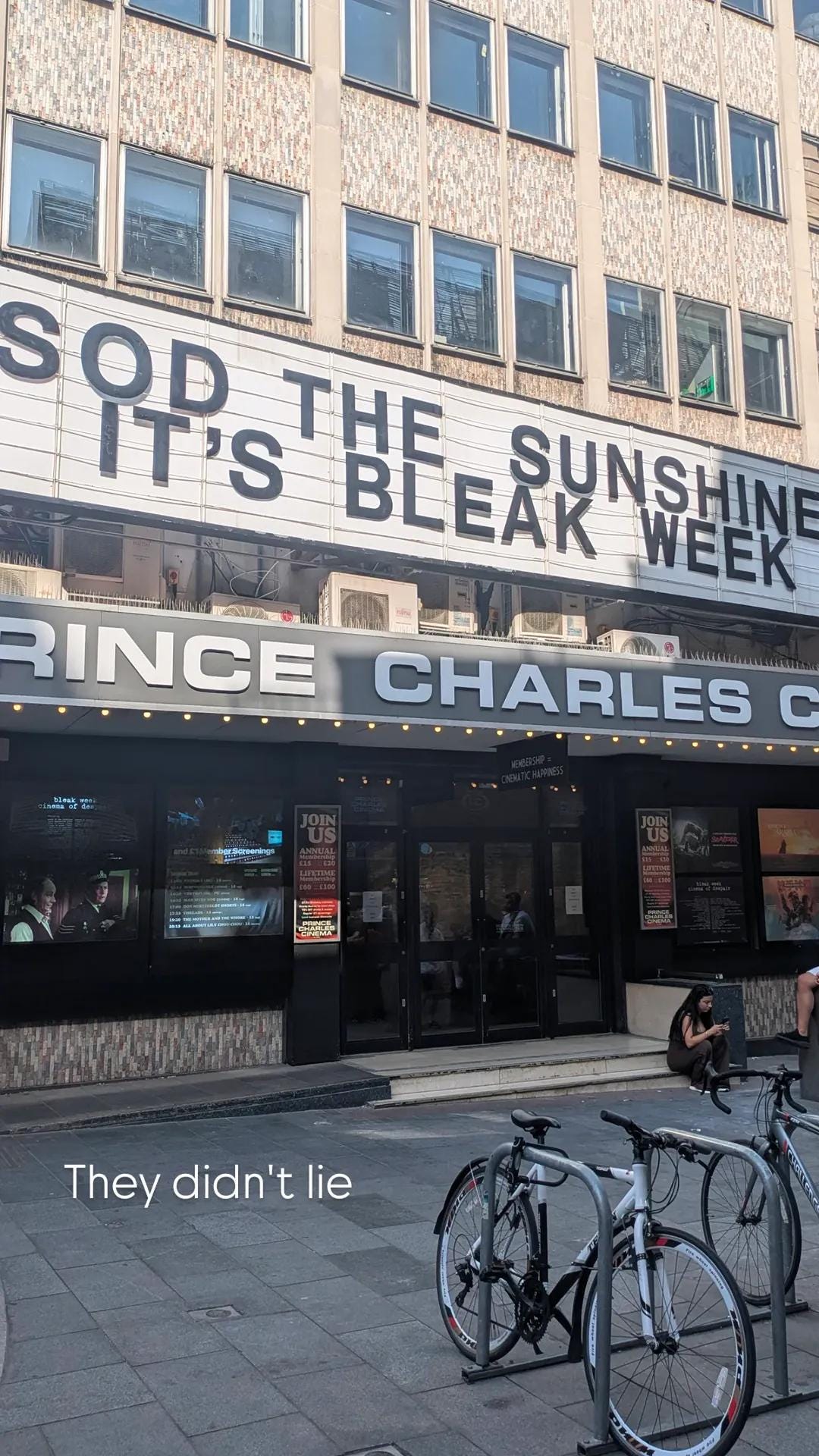
This was my first time seeing it, as part of the Prince Charles Cinema’s BLEAK WEEK, and they weren’t lying when they said it was bleak. There was not one single moment of happiness or joy in this relentlessly and increasingly horrifying PSA. I literally left the PCC and went to the church on Leicester Place so I could sit somewhere quiet and stare at a wall before making my way home.
If you haven’t seen it, allow me to enlighten you. If you have, you have my sympathies.
Set in 1984, it covers what might happen in the event of nuclear war breaking out and a bomb impacting the UK (the conflict in the film being largely between the USA, Iran and Russia was a bit too close to home…). Set in Sheffield, we meet young lovers Ruth and Jimmy, who decide to marry when Ruth falls accidentally pregnant. In the background of this, on the news and the radio and headlines of newspapers is the escalating conflict in the Middle East. When it becomes clear the previously-localized conflict—which has already seen nuclear weapons used—is going to become global, things take a sharp turn. Sheffield City Council officers are given powers to act as government in the event of a strike and they assemble in an underground bunker ready to take control. Food shortages and looting of shops begins, householders are taught how to assemble a fallout shelter in their homes and how to dispose of their dead.
And then the bombs go off.
First at a distance and then directly hitting Sheffield, a centre of industry and unfortunately located in proximity to airbases. Death comes quickly, we never see Jimmy again and his younger siblings and mother also die, leaving his father and grandmother exposed to radiation in their inadequate lean-to shelter. Ruth survives the blast in her parent’s cellar but leaves the shelter in search of Jimmy, heedless of the effects of radiation exposure on her baby. The streets are filled with the dead and dying – it’s taken just nine days for everything to collapse and Sheffield Council have all suffocated in their bunker after debris sealed it. Ruth returns home to find her parents murdered by looters and eventually ends up in Buxton, billeted as a refugee with a man who shortly throws her out and she gives birth to her daughter, Jane, in a barn.
Later we see the pair working in the fields in a futile attempt to try to rebuild society (I think everyone is basically forced into labour to rebuild the country. By everyone I mean normal people. I expect the wealthy and titled probably continued being just that and reaping the benefits of other people’s work). Ruth dies in 1994, grey and blind, somewhere in her early thirties but looking three times that. Jane, now aged around 13/14, who has grown up in a world where both language and the social contract have degraded as there’s not really anyone to teach them, becomes a looter and is eventually raped by another survivor, and at the end of the film she gives birth to a disfigured, dead child.
And that’s where it ends. Her father—who doesn’t die on camera—did not come back to find her, which was my naïve, standard-structure-of-Western-storytelling expectation. There is no hope. There is no joy. Everything is a struggle and your life is not your own and your body is not your own and death is a genuine mercy.
I have always maintained I have zero interest trying to be a survivor if the current world order collapses completely, because as a woman I can see exactly how that’s going to go for me and THREADS only reinforced that belief. I need there to be joy. I need there to be more than drudgery. I’d honestly recommend you don’t watch it if you ever want to feel wholly at peace again.
Hobby: Smoking Fish
Last Saturday I went to a talk about local fish smoking as part of Meet the Fleet – a series of events happening over the summer, in conjunction with Hastings Contemporary and the Hastings Fishermen’s Protection Society. Hastings has the last beach-launched fishing fleet in Britain, with just under twenty boats launching direct from the Stade. Most of the fish caught by the fleet is sold locally, some to shops and restaurants but mainly directly to customers who shop at the winch huts and the kiosks down near the Stade.


The talk was delivered by Tush Hamilton and Sonny Elliott, with additional info and fact checking by Pat Hamilton, Tush’s wife. Tush and Pat have been married for 59 years (Tush mistakenly thought it was 58 and was rapidly corrected), and they worked together for much of that time cold smoking locally caught fish and selling it through their shop on the High Street. Though Tush was unwilling to reveal the secrets of the smoke blend he used – there was a running bit where he insisted he wouldn’t tell us his professional secrets and also pre-empted Sonny’s revealing anything by demanding he didn’t – he did talk us through how the process of cold smoking fish worked back in his day (cold smoking is keeping the temperature between 20 and 30 degrees so the fish cures in the smoke but doesn’t cook), beginning with filleting and brining the fish. He showed us old pieces of the wooden equipment used back in the day; the tenterhooks and hazel rods for hanging mackerel, regaled us with stories of climbing the racks to hang and circulate the fish, of having to wait outside the hut in all weathers to keep the temperature of the fire regulated by controlling how open the door was, of accidentally hot smoking a bunch of salmon on order for Christmas (before hot smoking became a thing). It was clear it was hard, relentless work—many of Tush and Pat’s workdays were 18 hours long and spare time for relaxation and hobbies simply didn’t exist. But what was also clear was his love of his business and his life and the deep, deep connection he felt for the sea.
Sonny is a born and bred Hastings man, never living more than a few miles from the Bourne, where he was born. He inherited his parent’s business, developing it into the Sonny’s of Rock-a-Nore that exists now, which is probably the most popular fish shack in Hastings (it’s my favourite, anyway). Sonny’s make hot and cold smoked salmon, the hot smoked salmon is smoked in one of the kilns Sonny owns in his fishmongers on the Stade. Sonny talked about various ways of preparing herring and about local fishing stocks and seasonality, and then the two men began talking about all the bureaucracy and waste involved in being a fisherman in this modern era, bound by red tape and quotas despite having so little control over what ends up the nets.
It was a really warm and funny and super-informative afternoon and I’ve already booked for the next one, where I will learn about fish bread.
They showed us Threads in the last year of Primary School - that would have been 1994. I don’t think you would get away with that now