
Friday Five
19/06/2026

Friday Five
Every Friday I share five things that stuck with me from the previous week.
Place: The All Saints Church Doom Painting
Last Sunday I went to visit All Saints Church in Hastings to see a Doom. For those who don’t know (like me before last Sunday) a Doom is a fresco, usually of the Last Judgement, painted on the back wall to the west or at the front at the end of the chancel in Medieval churches. It’s given a prominent spot to maximise visibility for the congregation, because the purpose of a Doom was to put the fear of God (quite literally!) into people that couldn’t read and (for the most part) didn’t receive schooling or formal education. How better to demonstrate exactly what would happen to them if they strayed from the righteous path than with a very large and vivid painting showing the Devil cheerily immolating and hanging sinners? (You can’t have demonstration without demons, after all.)
Dooms typically depict scenes of Christ on Judgement Day, sending souls towards the kingdom of heaven on his right and to hell on his left (sinister, sinister!).
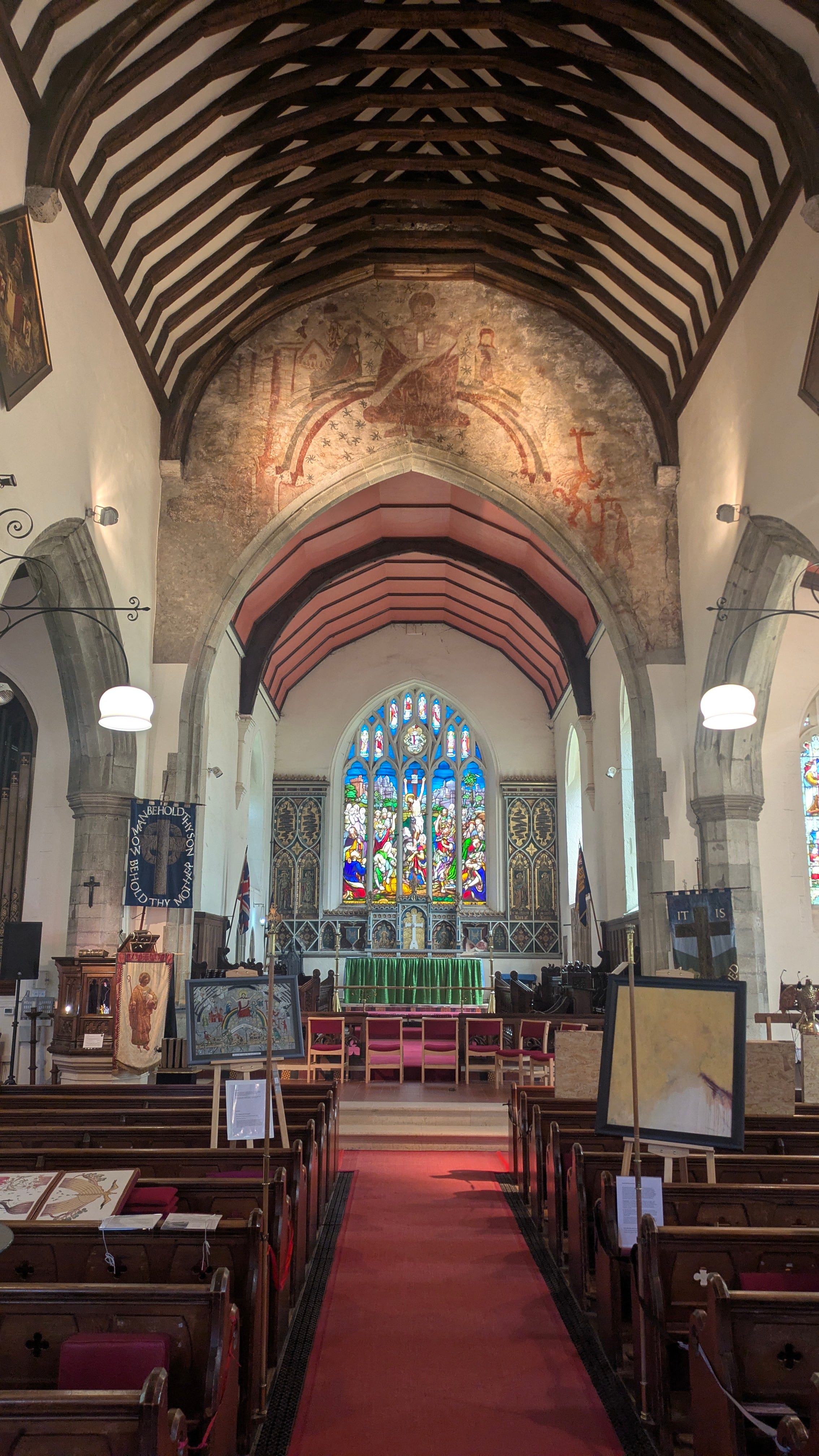
The Doom in All Saints Church shows the Last Judgement, Mary on his left, praying for the sinners and John the Apostle on his right (just hanging out? providing moral support? - my research didn’t clarify), with the paths to Jesus painted in red (sin and danger) and blue (heavenly things), (I didn’t know any of this before I went, but there are some pretty good resources online if you want to learn more, too!).
Many Dooms were covered up during the Reformation and only rediscovered later, often when the plaster used to cover them flaked away due to age. The Hastings Doom was rediscovered in 1870 and restored in 1935 and the church itself dates back to 1430, though there was a church there, built in 1020, which was destroyed in 1377 during the Hundred Years War.
There are roughly sixty Dooms left in the UK and the one in Hastings was on show as part of an art exhibition over two weekend, showcasing art in conversation with the idea of Doom from a modern perspective. There was, as you might guess, a big focus on social media and AI. Real Doom shit.
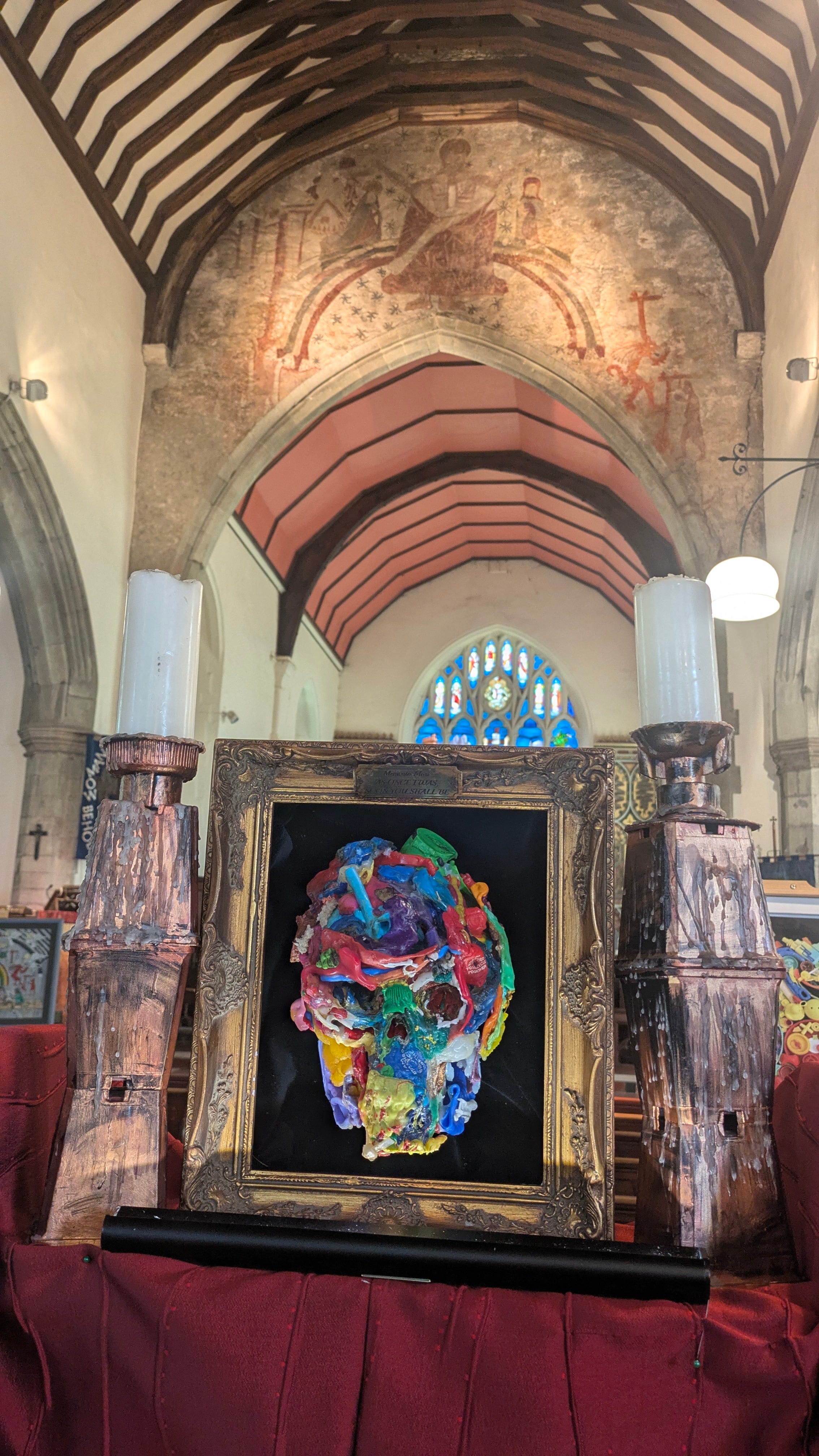
I especially wanted to see the Hastings Doom because it’s mentioned in my friend Jake’s forthcoming book, Netherwood! Netherwood is about a couple who move to the seaside town of Hastings (my town!) and find themselves living in the former home of a notorious local occultist over whom the shadow of former town resident Aleister Crowley looms large (there’s a fun local legend that Crowley cursed Hastings so anyone who lives here can never leave, which goes a long way to explaining the A21 and also our train services. Cheers, Al). And so now when I read Jake’s book I’ll be able to picture exactly what he’s talking about and that will be lovely for me.
Film: A Life on the Farm
I volunteer at the Electric Palace Cinema in Hastings and A Life on the Farm was June’s Strange Frames screening. Strange Frames is a film strand curated by Katie Spooner, dedicated to celebrating the offbeat, grotesque and arcane. I try to always work the Strange Frames screenings because they’re inevitably incredible and subversive and they open up new rooms in my head, which is all I want from anything really.
A Life on the Farm explores the life of Charles Carson, a Somerset farmer who spent a lot of time making home videos of his day-to-day life and distributing them to his neighbours and friends. It begins with director Oscar Harding recounting the vague memories of a surreal home video he’d watched as a child. It had featured an old man and his much older mother, sitting in front of a fireplace surrounded by brass… And then the old man revealed his mother had died and this would be her last time on camera. At which point Oscar’s father turned the tape off and it was never spoken of again. But Oscar – for obvious reasons! – never forgot about it and while he was clearing out his grandfather’s old tapes he came across the tape, rewatched it, and a passion to learn more about Charles Carson began.
A Life on the Farm is a result of that curiosity and searching, combining more found footage from the farm with inteviews from talking heads who either personally knew Charles and or who’d also come across some of his many, many tapes. The film begins with the most outrageous moments – the death and burial of Pandy, a beloved farm cat, whose on-camera funeral is given state pageantry levels of recording and pomp, the birth of cows and extreme close-ups of placentas, the death of Millie, Charles’s mother, and her three-day posthumous tour of the farm.
But then the shockumentary approach is dialled back and we learn about the man and the life he led as a husband, father and teacher before returning to Coombe End Farm and taking it over. It would’ve been very easy to sensationalise and mock the eccentricity of Charles, but the film really lauds his creative spirit and his endless desire to communicate his life and his world with people outside of the farm. His work is surreal and dark at times, but at the same time it’s wholesome and earnest. Charles sets up skits and bits with paper skeletons and his horses, annotates photos with jaunty hand-written captions. He films everything and anything, endlessly committed to his art and to sharing it. He wants to be seen!
And he reaps the rewards in the end, both in his own life when his work is nationally recognized and in the making and distribution of this film. I sat in a cinema with a bunch of people to see his world and it would have delighted him. “Well, there we are. That’s life on the farm.”
Book: Artists, Siblings, Visionaries by Judith Mackerell
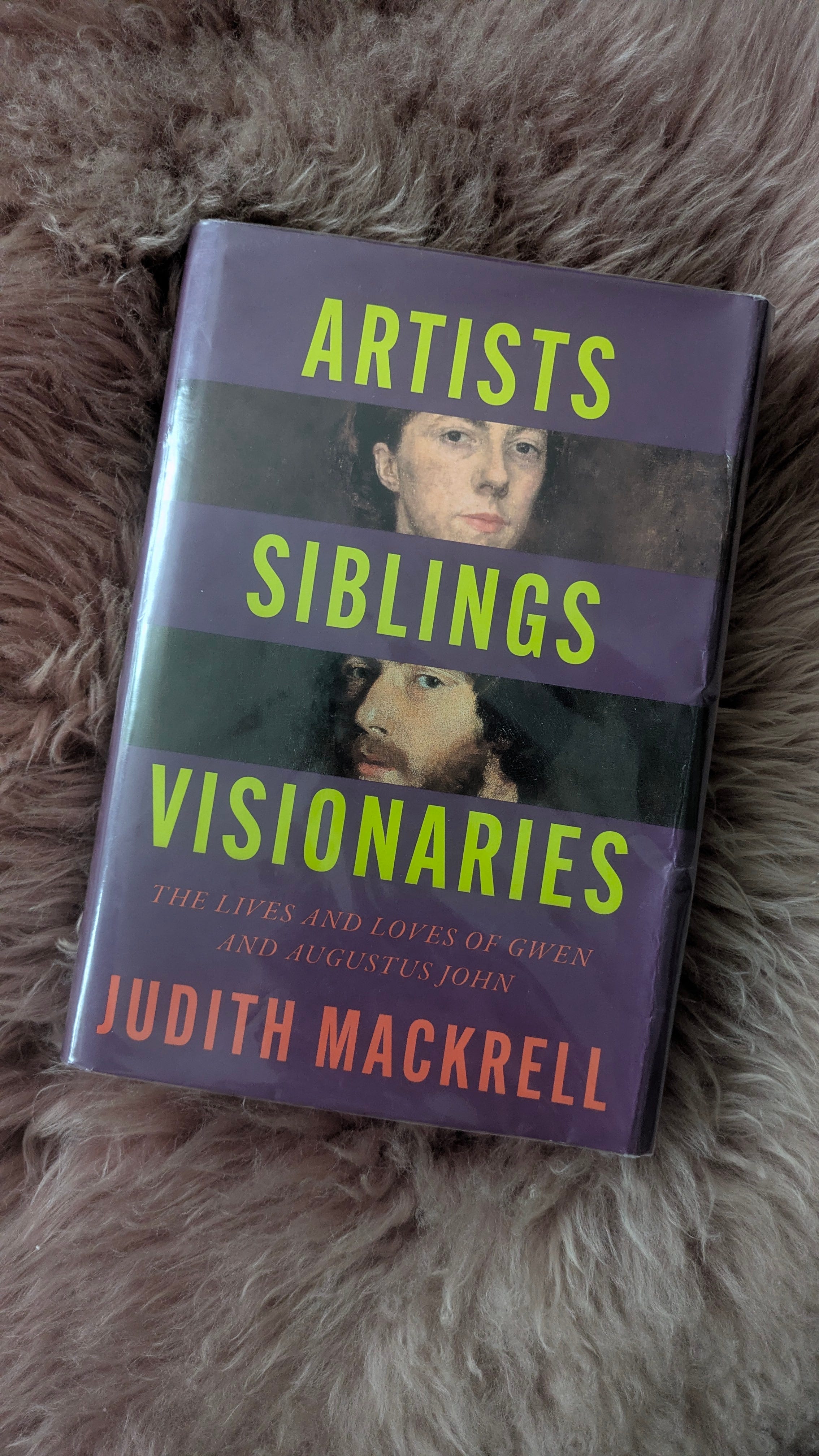
I can’t remember what made me reserve this at the library, but I’m glad I did. It’s a biography of siblings Augustus and Gwendoline John, both of whom became artists, studying at the Slade in London (one of the few places that allowed female students). Gus is a handsome dandy; exuberant, rakish, dramatic and bold. His sister Gwen is his paler shadow; introverted, private, prone to anxiety and attracted to both men and women. And of course, her talent was underrecognized and underacknowledged during her time. While both of them laboured over their craft and committed to it wholeheartedly, it was significantly easier for one of them and that’s where the tension in the book comes from.
I became so sympathetic to Gwen that I started to see Gus as a kind of villain because of the apparent ease he attains his desires – even though he isn’t (I mean, he’s a feckless cad but he’s not evil)! It’s not his fault he’s a man nor is it Gwen’s fault she’s a woman. They’re both playing the hands they have and it’s simply that the game is set up to favour one of them more.
Something that really struck me about Gwen was how brave she was and how much of an outlier of the time. She and her fellow female artists understood that marriage and motherhood would end up superseding their artistic hopes but Gwen was the only one who refused to succumb to it (the Rodin thing was a bit touch-and-go at one point though). Against all the mores of the time, Gwen persevered in following her ambition and fought for every (meagre!) scrap of recognition and acclaim she earned. And I feel that in my soul when I realise how much harder I have made my own life by not tethering it to a man’s. How much more secure I’d be if I had someone else’s income underpinning my career. How much more easily I’d be accepted if I’d done what women—even now—are supposed to do. But at the same time I can’t help think about what I’d have to give up for that security. How much would I have had to compromise to gain it and would it truly have been worth it? Could I have the life I have if I’d done it the other way?
One thing that really stuck with me is how, aged twenty-three, Gwen deliberately sat on a rock to see what would happen if the sea swept her out. She wasn’t trying to end her life, but rather, the book says, “to see what would happen.” It reminded me of a paragraph earlier in the book where Gus dives from some rocks into the sea and hits his head. He survives and recovers and is changed by it, this is when he becomes outlandish and bold, his already-enviable talent seemingly increased, “he dived into the sea and came out a genius,” is one quote about the event. I wonder if maybe some part of Gwen was subconsciously trying to recreate the same baptism her brother had undergone, hoping to be reborn recognizably brilliant and to have a legend of her own to act as a foundation to her work.
It’s fascinating to see these two artistic luminaries living side-by-side, existing in the same world but in such different ways. And fascinating to see such a clear view of artistic life in London at the time, before the Impressionists began upending everything about artistic sensibility that had come before. Gwen was a modernist who’d defined her artistic voice very early in her career and continued to refine it, but Gus – who’d long struggled to find his style – was blindsided by the new movement. And it seems Gus understood what the then-world had not about his sister’s artistic merit, gloomily claiming towards the end that, ‘In 50 years’ time I will be known as the brother of Gwen John.’
Hobby: Birds
Over Christmas I was introduced to the Merlin app, at approximately the same moment in time as pretty much everyone else it seems. I don’t hold with conspiracy theories but there is something a little spooky about so many people suddenly getting into this very specific app, which is designed to help you identify birds, primarily by song (though you can do photo ID too, for the birds that refuse to cooperate and sing on command).
I’m now living a life where at least once a week I go out into the wild with the sole intention of identifying a new bird for my Life List. It used to be about fresh air and communing with nature and witchy stuff, but now it’s about twitchy stuff (I’m sorry). I’m out there playing adult Pokémon and trying to collect birds. I currently have 93 birds in my Life List, my favorite is the cuckoo, but I think the fanciest one I have is probably the white stork. It’s only a matter of time before I buy a cheap flight to Spain to get some real sweet Spanish birds. If I thought I’d be allowed into the USA, I’d be there now, racking up cardinals and hummingbirds and blue jays.
If it turns out we are living in a Sim and the reason that I (and everyone else) am suddenly into Merlin is because our players got a discount expansion pack for bird listening, I’m OK with that. I’m also really grateful to my player for not enrolling me in the Dubai chocolate or Labubu expansion packs.
Hobby: Commonplace Books
Also over Christmas I got really into the idea of Commonplace books. I’d inadvertently been keeping one since 2023 but I didn’t realise they were a more formal thing or that they had such a lovely history.
On the off chance you, like me, didn’t know about them (maybe you did know about them because you read the Lemony Snickett books, good for you!), allow me to explain.
A Commonplace Book is notebook that acts as a scrapbook of quotes and thoughts and facts and feelings and measurements and pretty much anything a person keeps because they want to remember or consider something more deeply. In the 17th century Commonplacing was taught to university students to help them with information retention while they were studying. They’re often organized into subjects and sections, but mine never have been and I’m not inclined to start now.
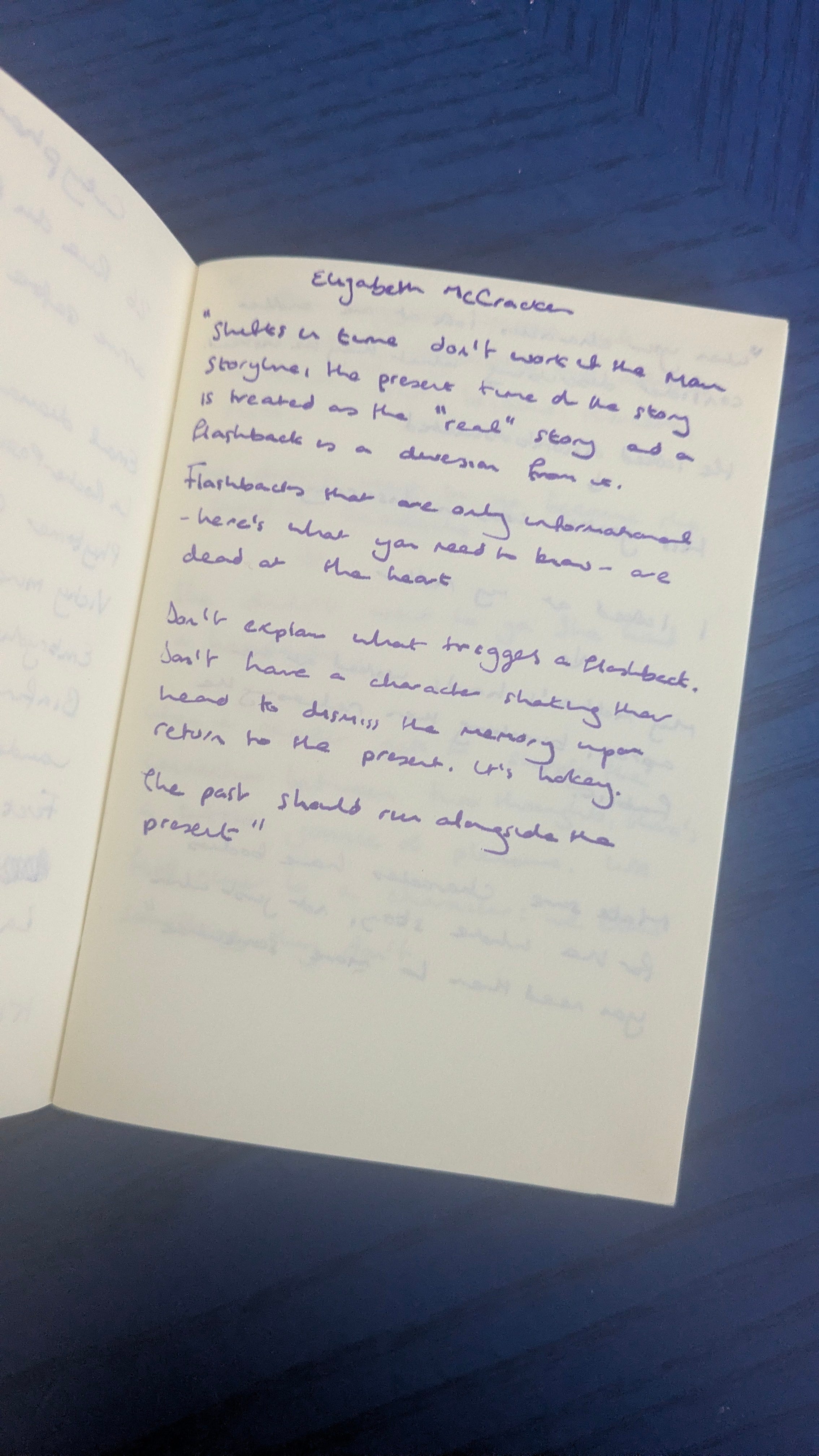
In 2023 I started carrying a notebook with me everywhere for the sole purpose of recording thoughts I had and things I heard and quotes I wanted to remember, especially when I was at the theatre or cinema and the moment was fleeting but I didn’t want to lose it under something else. And I enjoyed the process so much I kept it rolling – every year when I buy my new diary I pick a new Commonplace book. It has to be small enough and light enough to fit in a pocket or small bag and it has to be nice paper. It’s a lovely thing to have and to look back on at the end of the year, especially if you’re like me and you can’t do Morning Pages or journalling for more than a couple of weeks because it makes you sick of yourself.
Some of the entries from this years’ so far include:
A list of films I want to see
A quote by Johan Grimonprez
The definition of Haustoria
A list of things to buy in Parisian pharmacies while I’m there
The recipe for Erdbeerkucken (written in German)
A note to find somewhere in London that serves Moroccan breakfast
Quotes from Elizabeth McCracken’s book on writing
A story idea (this was copied into my Official Ideas Notebook)
“Maybe Eve ate the apple on purpose, to get out of Eden and away from Adam” (charming little thought I had there).
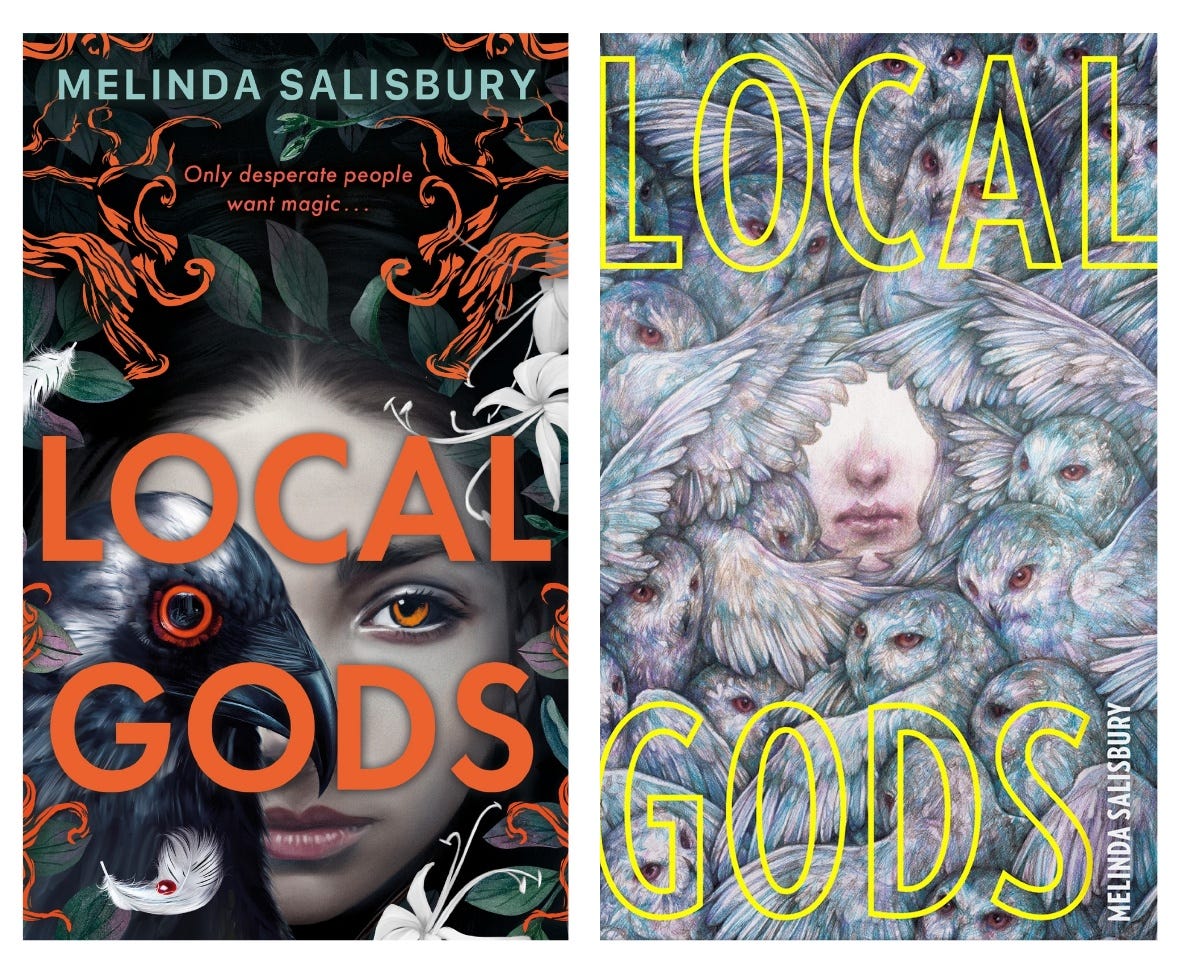
And finally, not a Friday Five, but a reminder my next book, LOCAL GODS, a YA folk horror about an outcast girl who meets a dying god in the woods near her home and believes if she helps him she might get her old life back, is out in just six weeks. Pre-orders mean everything to authors - marketing budgets are responsive and if my publishers can see there’s a demand for the book they’ll invest more in raising its profile.
UK readers can preorder from Waterstones, or your favourite indie
And US readers from Barnes and Noble, or your favourite indie.
Until next time…